
 Place-Based Strategies
 Innovation & Supply Chains
From “Podu” to “Premium”: How Koraput Coffee brewed a local economic transformation
In one of India's most marginalised districts, the Koraput administration resolved a decades-old coordination failure between farmers, processors, buyers and lenders, turning a subsistence crop into GI-tagged premium coffee with a guaranteed farm-gate price.
16 minutes reading
A coordination failure, not a lack of schemes
There was no dearth of schemes. The real constraint was the absence of anyone whose job was to converge the schemes on a single outcome.
From convening to market shaping
With coordination as its foundation throughout, the local leadership built a market-shaping strategy, intervening on the supply side to get quality coffee grown and processed, and on the demand side to brand it, win recognition for it, and place it with specialty buyers.
Credibility built on visible gains
Each visible gain, a price floor that was honoured and then raised year on year, payment reaching a farmer's account the same day, a curing unit that plainly worked, built the credibility that persuaded the next risk-averse grower to join and each line department to keep converging on the shared goal.
Set in the Eastern Ghats at around 3,000 feet above sea level, Koraput is a predominantly tribal district in the hills of southern Odisha. For generations, its tribal farming communities practised podu — a form of slash-and-burn shifting cultivation that stripped the hillsides bare and yielded just enough to survive. Today, the same hillsides produce a premium Geographical Indication (GI)-tagged Arabica coffee and have enabled their growers to transition from subsistence farming into a premium, globally recognised value chain.
This economic turnaround was not the product of a single subsidy or a fortunate harvest. It was engineered by a district administration that chose to act as a system orchestrator, stepping in to resolve the coordination failures that had long kept farmers, processors, buyers, and lenders trapped in a low-value equilibrium that none of them could escape alone.
The Baseline: A Coordination Failure
Koraput’s laterite soils, cool climate, and high rainfall are textbook conditions to grow Arabica coffee. Coffee was first introduced to the region in the 1930s by the then Maharaja of Jeypore (Rajbahadur Ram Chandra Deo), who planted an estate near the Kolab basin at Bicholkota.
But for decades the crop generated almost no wealth for the people who grew it. Traders from neighbouring Andhra Pradesh would arrive at harvest, weigh the berries, pay a few rupees per kilogram, and leave. The same beans would then be processed, branded, and sold at a significant multiple by the traders, sometimes under the label of “Andhra Coffee.” Rajma Chautia, a resident of Golur village in Nandapur block in Koraput describes this sales arrangement plainly: “Though we have been growing coffee for over a decade, we had to sell it at throwaway rates. Traders would buy from us at ₹10 to 15 per kg.”
The trap was not just low prices. It was a classic case of coordination failure farmers would not cultivate at scale without an assured buyer. Processors would not build local infrastructure without an assured supply. Buyers would not commit to Koraput-origin coffee without consistent quality and volume. Lenders would not extend credit without any of the above. Ever since those first estates were planted in the 1930s, no single private player had the incentive, or the capacity, to break this deadlock.
The cost of this stagnation was distress migration. With coffee offering no real income, tribal families left each year after the planting season to nearby states, often to work in brick kilns.
Koraput sits in the old Koraput-Bolangir-Kalahandi (KBK) belt, one of India's most persistent pockets of deprivation, where around half the population has lived below the poverty line1 on small rain-fed plots that could not carry a family through the year. Across the belt this seasonal outflow runs on a system known as Dadan: recruiters move through the villages after the autumn harvest, offering cash advances against a promise of work. A family that takes the advance is bound to it, working off the debt over roughly six months with wages set against what they already owe; and because those earnings rarely cover the rest of the year, the cycle renews itself annually2.
District Administration as the key coordinator
In May 2017, the Koraput District Administration, led by Anupam Saha, an Indian Administrative Services (IAS) officer, established the Coffee Development Trust (CDT), a dedicated local platform to de-bottleneck coffee cultivation and execute a ten-year roadmap aimed at bringing an additional 22,000 hectares under cultivation. This move was motivated by a sense that the district's potential had gone unrealised. "The potential was obvious," Saha recalls. "The Coffee Board of India identified around 1.5 lakh hectares across Koraput and the surrounding area conducive for coffee plantation, and Araku just across the border in Andhra Pradesh, had already proved coffee could grow in these hills. What was missing was a single authority to drive it." The CDT bore this out quickly, bringing 500 hectares under cultivation in its first year alone.
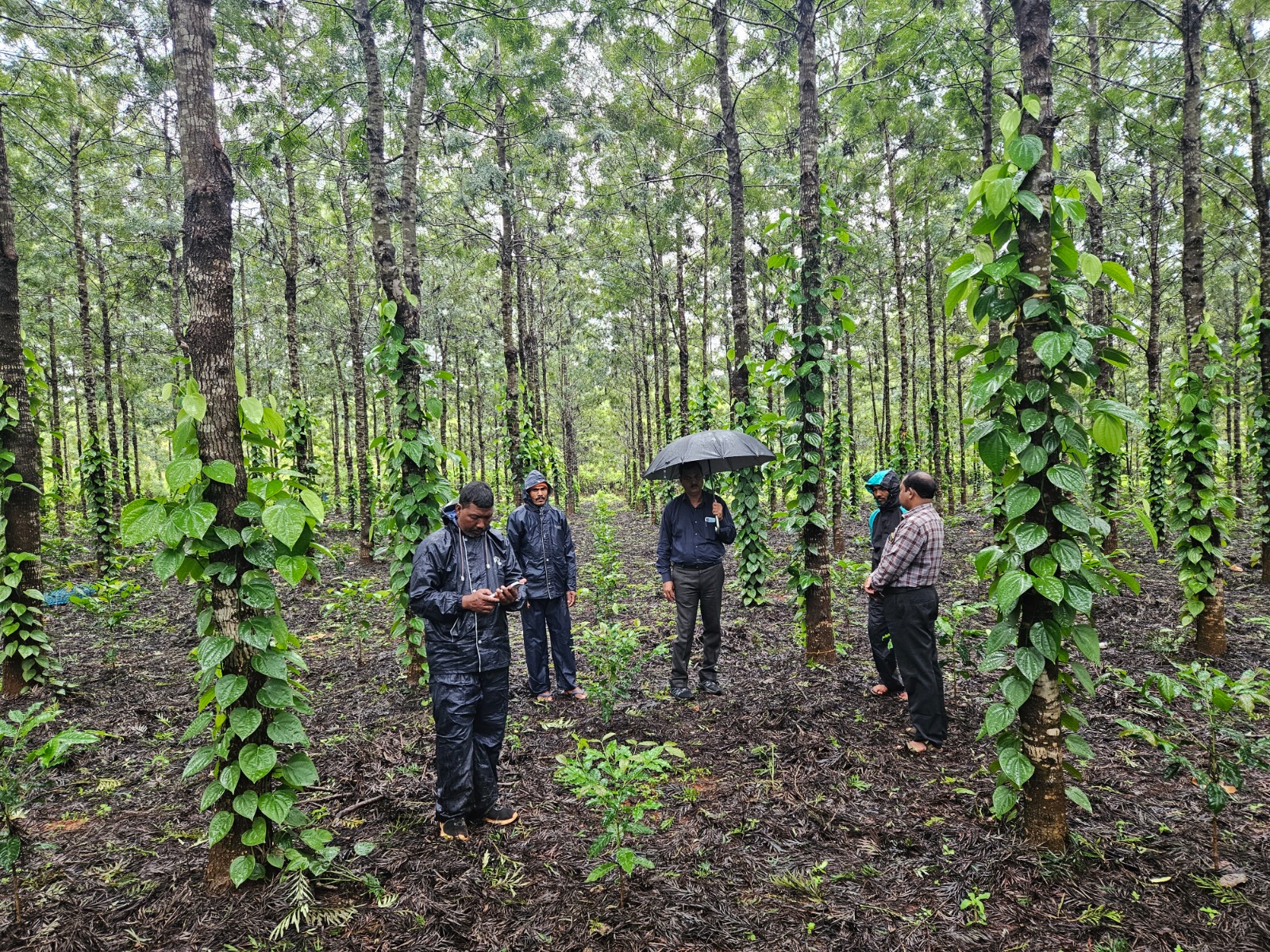
CDT’s early work was agronomic and slow by design. Coffee is a shade crop and hence it cannot simply be planted on an open hillside. The early years went largely into a shade-plantation drive: establishing the silver oak and other canopy cover under which coffee would later be planted. This encouraged more tribal farmers to participate in coffee cultivation.
But the Trust's success in getting more farmers to plant soon exposed a different failure. As plantations expanded, growers found they still had nowhere to sell. Middlemen from Andhra Pradesh continued to buy the cherries cheaply, because Koraput had no processing capacity and no organised buyer of its own. The agronomic bottleneck had been cleared but a marketing bottleneck now stood in its place.
Phase I: Infrastructure and Price Assurance (2019-21)
By 2019, having used the Trust to get coffee into the ground, the administration turned to the problem of getting it to market at a fair price. The inputs Koraput's coffee farmers needed were already notionally available but they sat in separate departments, each answering to a different authority, none with coffee as its focused mandate. Plantation labour could technically be funded via the Mahatma Gandhi National Rural Employment Guarantee Scheme (MGNREGS)—a federal employment program—but it was administered for rural employment, not crop development, and consequently, the projects funded under it were approved against employment targets rather than output.
Saplings and agronomic training lay with the Coffee Board of India, a central body under the Union Ministry of Commerce and Industry. Procurement and processing capacity belonged to the Tribal Development Cooperative Corporation of Odisha (TDCCOL), an apex cooperative under the state's Scheduled Caste and Scheduled Tribe development department. The legal right to plant on forest land depended on Forest Rights Act titles, processed through yet another channel. Each individual government agency, operating within its own unique mandate and policy supply chain, had no reason to synchronise its decisions with the others. So a tribal farmer could receive saplings in a year where he had no labour support, or labour support on a forest land he had no title to. There was no dearth of schemes. The real constraint was the absence of anyone whose job was to converge the schemes on a single outcome.
Madhusudan Mishra (IAS), the then District Commissioner of Koraput, took on this convening role. Leveraging his authority over all district-level line departments, he aligned them around one shared, measurable goal: getting tribal farmers to plant, harvest, and sell coffee at a fair price. In practice this meant directing MGNREGS works toward plantation labour, sequencing Forest Rights Act titling so that land was secured before planting, timing the Coffee Board's sapling distribution and training according to the planting calendar, and positioning TDCCOL to buy the resulting produce. None of these bodies was new; what was new was a single authority holding them to a common timeline and a common objective.
Taking this entire value chain approach also helped uncover the gaps in existing policy supports. TDCCOL’s response was to build some of this missing infrastructure itself. For instance, Mansi Nimbhal, then Managing Director of TDCCOL recalls that there were no existing post-harvest machines. “So the curing unit, along with the full supply chain, was built to market Koraput Coffee — a brand that could give direct income to the tribal growers.” That unit was the first such facility the district had ever had, and it changed the economics of the crop. TDCCOL now bought cherries at the farm gate, de-pulped them the same night, sun-dried the seeds, and then roasted and packaged the product under the Koraput Coffee brand, processed at its Sunabeda unit.
The procurement price was set at ₹35 per kilogram, roughly triple what traders had been paying until then. This would rise steadily in the years that followed, reaching ₹105 per kilogram by 2024–25. A guaranteed price and a working processing chain, however, only mattered if farmers were willing to plant in the first place. That willingness depended on secure access to land. With Forest Rights Act titles in hand, farmers could cultivate community and fallow forest plots without fear of eviction, and TDCCOL's Coffee Development Trust began actively encouraging them to do so through its cadre of field officers.
"Though tribals in Koraput had grown coffee earlier, it was in fits and starts," says Ashutosh Nanda, TDCCOL's District Manager for Koraput. "After the price floor and streamlined payment system by the government, tribals are being motivated to grow it on their forest land, or on fallow land near their villages. We tell them about the economic benefits and how we can help."
A workforce component ran alongside this. The Coffee Board trained farmers in post-harvest handling, shade management, and disease control. The Odisha Livelihood Missions employed tribal residents, many of them women, in government coffee nurseries for months at a stretch, using techniques prescribed by the Board. The binding constraint was not the absence of skills but more the absence of demand for these skills. Cultivation know-how had long existed in pockets, but only once assured procurement created a reason to produce did training become worth absorbing at scale. According to Ashutosh Nanda, TDCCOL's District Manager for Koraput, farmers readily take to the cultivation training but consistently ask for more guidance on marketing and pricing.
2019 also brought a second turning point: Koraput Coffee received a GI tag, included under the broader "Araku Valley Arabica" classification3. This GI tag was a result of a strategic push by the Government of India's Ministry of Commerce and Industry to leverage intellectual property for agricultural exports. The Agricultural and Processed Food Products Export Development Authority (APEDA) has argued for standalone recognition for Koraput Coffee, which would carry stronger brand equity in global specialty markets. But even if imperfect, this tag served as a signal of origin and quality to urban and international buyers, who had never heard of Koraput.
Phase Two: Building the Market Stack (2021–2023)
The question now was no longer whether farmers would sell to TDCCOL, but if Koraput Coffee could reach national and international markets at the volume and quality consistency that serious commercial buyers demand. Under this phase, the District Administration and TDCCOL jointly answered that question by curating a set of institutional relationships.
In August 2021, a partnership between TDCCOL and Tata Coffee, one of India's largest integrated coffee companies, connected Koraput to a credible national and international buyer, and the quality benchmarks it brought gave the brand commercial legitimacy beyond government outlets. Following this, the district administration integrated other programs: Mission Shakti, Odisha's program for women's self-help groups (SHGs), and the Odisha Rural Development and Marketing Society (ORMAS) drew women into village-level procurement and nursery operations, turning a historically male-dominated cash crop into a source of organised income for women.
The women’s self-help group nurseries became the most visible women-centred institutional innovation in the programme. Fourteen women’s SHGs across eight blocks now raise coffee seedlings from germination to transplant stage — supplying them to new plantation beneficiaries at subsidised rates and targeting some 11,00,000 seedlings for the 2026–27 planting cycle — while their members also handle cherry collection, sorting, and weighment at village procurement camps during harvest. This gave women a stable, non-seasonal income stream, though for now their role remains concentrated at the nursery stage of the value chain4.
In 2021, Odisha’s Chief Minister Naveen Patnaik launched the koraputcoffee.org portal and a chain of dedicated Koraput Coffee cafes; the product also went live on Amazon and entered Adisha, the state government's retail outlets.
The numbers tracked these initiatives. TDCCOL’s structured procurement, the clearest measure of farmers reaching an organised buyer, rose from 28.79 metric tonnes bought from 193 farmers across 13 villages in FY2020–21 to 84.56 metric tonnes from 314 farmers across 23 villages in FY2022–23, at a procurement price that climbed from ₹35 to ₹55 per kilogram over the same period. Domestic sales of roasted coffee and the “Tiger Bright” retail brand grew in step, from about ₹3.4 lakh in FY2020–21 to roughly ₹57 lakh in FY2022–23. At the upper end, farmers cultivating larger plots of two hectares or more could earn well over ₹1,00,000 a year from coffee.
What those figures meant for individual families is easy to understate. One resident, Binda Badanayak, held two acres under the Forest Rights Act on which he grew only paddy and millets, earning about ₹5,000 a year. He planted coffee in 2018. Four years later: “I got a little more than ₹36,000 in a year after selling nearly 800kg of coffee cherries that I grew on my land. It has changed my life. My daughter just finished her higher secondary education and wanted to study further. Till now I had thought I would not be able to afford it.” Thirty-eight other farmers in Punjsil sowed coffee the same year; together they earned ₹4.4 lakh from 9.7 tons of produce.
Phase Three: Quality as a Competitive Strategy (2024–2026)
In recent years, under the then District Commissioner V. Keerthi Vasan (IAS), the goal has evolved from volume to value, from selling more coffee to selling better coffee at a higher price. The aim is to establish Koraput on its own terms. “The primary idea was to take Koraput Coffee to global standards,” recalls Keerthi Vasan. “Araku was historically popular, and Koraput was treated as an extension of it. It was time to come out of Araku’s shadow — the flavour was already distinct, and the recognition gave it independent standing.” That distinctiveness is not incidental: grown under natural forest canopy, intercropped with mango, jackfruit, and pepper, and cultivated without synthetic inputs, Koraput’s Arabica carries a low acidity that specialty buyers value.
Two operational shifts underpinned the strategy. First, TDCCOL moved decisively to doorstep procurement: collecting ripe cherries at farmers’ doorsteps, managing drying, grading, and marketing end-to-end, and paying directly into farmers’ bank accounts within 24 hours. By FY2025–26 this reached its widest coverage yet: 102.54 metric tonnes procured from 360 farmers across 28 villages, at a floor price of ₹105 per kilogram against private-buyer rates of roughly ₹130–150. The total payout to farmers that year crossed ₹1.10 crore, the highest in the programme’s history5. Second, the administration pushed the product into national quality competitions.
The recognition came at the Flavour of India — Fine Cup Award 2024, organised by the Coffee Board. Koraput Coffee's Arabica Washed and Arabica Natural varieties each won awards, placing the district fourth overall in a national ranking of India's finest coffees. This result positioned Koraput within an Indian specialty coffee narrative long dominated by Karnataka. The independent recognition translated into direct market access: specialty roasters, among them the coffee chain Café Coffee Day (CCD) and Kruti Coffee6, have since begun sourcing Koraput coffee.
Looking ahead
Vasan was candid about the model’s fragility. “Coffee is a long-gestation crop, and no Commissioner will have that long a tenure,” he notes, highlighting a more profound challenge around program continuity across bureaucratic change. His solution was to institutionalise the knowledge: Coffee Mapper, a GIS tool that maps existing coffee-bearing land, areas with potential, natural shade cover, and tree pattas (forest-land titles), giving the district a spatial base for systematic expansion that outlasts any one Commissioner. The next levers, he suggests, are bringing private players into procurement for global reach and securing a separate Geographical Indication for Koraput. Bottlenecks remain. The reach of organised procurement is still narrow: even in its peak year, TDCCOL bought from 360 farmers across 28 villages, a small fraction of the roughly 7,051 registered coffee growers in Koraput district. Berry leakage to Andhra Pradesh traders persists, the shared Araku Valley GI tag still dilutes Koraput’s identity, and most growers continue to farm small plots — averaging under a hectare — with limited access to credit. These are real constraints, and addressing them will test the institutional architecture built so far.
But these bottlenecks should not overshadow what has been achieved. In one of India's most marginalised districts, tribal farmers who once migrated for survival now anchor a globally competitive value chain. What began as a coordination exercise — aligning local departments that had every input the sector needed but no reason to act in concert — grew into something more ambitious. With coordination as its foundation throughout, the local leadership built a market-shaping strategy, intervening on the supply side to get quality coffee grown and processed, and on the demand side to brand it, win recognition for it, and place it with specialty buyers. The Koraput administration did not just convene a stalled system; it created a high-value product and the market to absorb it.
Part of what made this durable was the way the administration broadened local support: by demonstrating palpable transformation incrementally. Each visible gain — a price floor that was honoured and then raised year on year, payment reaching a farmer's account the same day, a curing unit that plainly worked, speciality coffee roasters signed on as buyers, National awards that were won — built the credibility that persuaded the next risk-averse grower to join and each line department to keep converging on the shared goal.
Over nearly a decade, strategic sequencing broke a deadlock which had blocked the region's inclusive economic growth for generations, turning a subsistence crop into a premium brand. Koraput Coffee stands as a genuine case of economic transformation led by local leadership.
- NITI Aayog, National Multidimensional Poverty Index: Baseline Report (2021) ↩
- Umi Daniel, Aide et Action, in "Chained by Debt," The Federal, 2024: KBK migration "is simply debt bondage. ↩
- Santosh Sahu, Mohit Agrawal & Guru Daaman Shrivastava, "Geo-Tagged Coffee from Koraput: Analyzing Branding and Market Penetration," IJPREMS 5, no. 6 (June 2025) ↩
- Koraput Coffee District Report, 2025–26 (TDCCOL / Odisha Government programme data) ↩
- Koraput Coffee District Report, 2025–26 (TDCCOL Annual Reports 2020–26 / DBT records) ↩
- Kruti Coffee: Odisha's Homegrown Specialty Coffee Brand," kruticoffee.com, 2026 ↩

Shashwat Shah

Place-Based Strategies
Demo: Placeholder description of the approach. Lorem ipsum dolor sit amet, consectetur adipiscing elit, sed do eiusmod.







 Demo: Author Name